An introduction to Bluetooth Channel Sounding
by Kyle Golsch, Principal
Many interesting applications can be built using distance or positional awareness. Everyone knows the experience of unlocking your vehicle when your key is nearby, or finding your keys or luggage by adding a tag. Although these seem simple, estimating distance with a radio is harder than it looks. The systems behind these applications have typically been a patchwork of radio technologies: one to wake the device, one to carry the data, and, after relay attacks appeared, another added just to estimate distance securely. For years the goal of low-power, low-complexity localization has been elusive. Channel Sounding changes that. It is built upon the ubiquitous Bluetooth ecosystem, and it brings true distance awareness to the devices people already own.
What came before Channel Sounding?
The obvious place to start is the strength of the received signal, known as the received signal strength indicator (RSSI). The louder the signal is, the closer the transmitter is; the quieter it is, the farther away it is. This feels like it should work. However, the real world conspires against it. Walls reflect, bodies absorb, and the received power swings for reasons that have nothing to do with the distance. Move the device from your hand to your back pocket and your body can weaken the signal by a factor of 100 (20 dB) without changing the distance.
The Bluetooth 5.1 specification added Angle of Arrival (AoA) and Angle of Departure (AoD). AoA/AoD differs from RSSI in that it uses the phase difference between two or more antennas to estimate the angle to the transmitter. The figure below shows how AoA works. The angle of the arriving signal creates a small time difference between when the signal reaches one antenna and when it reaches another. That time difference results in a measurable phase difference between the antenna elements that can be used to compute the direction to the source using simple trigonometry.
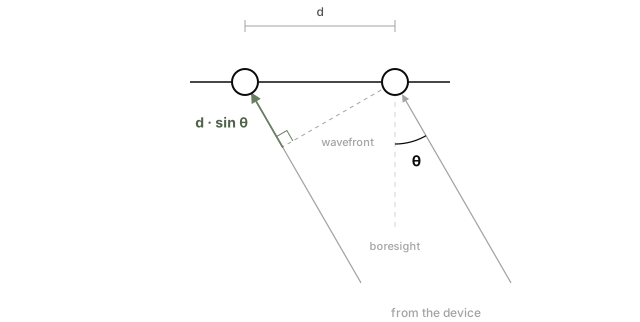
The figure above also suggests the challenges of using AoA. The receiver needs multiple antennas separated by a known distance. This is known as an antenna array. Antenna arrays can be large and costly to produce. For many applications, the cost, complexity, and even the physical size constraints conspire to make AoA impractical.
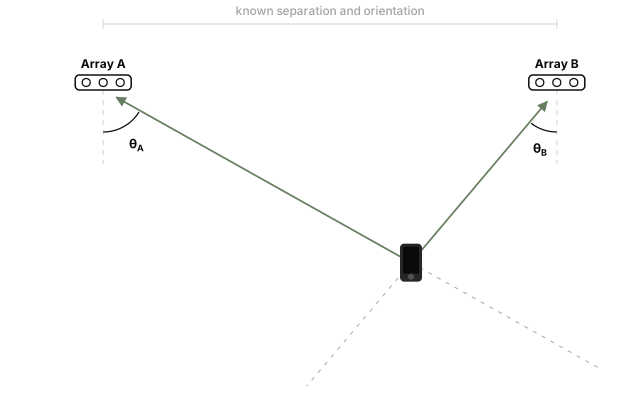
Another challenge is that an angle to the source is not a distance. The figure below shows that the angle measurements (θA and θB) from multiple arrays can be used to determine the position of the source. Now the system requires multiple, often complex and large arrays. For many applications, this is simply not feasible.
Channel Sounding was designed with these challenges in mind: no exotic antenna arrays, just simple exchanges between two inexpensive radios, and finally a single technology for distance-aware applications. Let's see how it addresses the challenges of the past.
What makes Channel Sounding different?
The reason why RSSI and AoA/AoD cannot produce a distance is that the information flow is in one direction. An RSSI system only observes the power of a signal and guesses how much power was lost due to the distance. An AoA/AoD system uses the observed phase difference between antenna elements of the transmitted signal and estimates the angle, which is a direction, not a distance. A one-way signal always arrives carrying an unknown: the receiver can measure a phase or a time of arrival, but it cannot know when the signal left, because the two radios do not share a clock. And any scheme that synchronizes the clocks is two-way communication in disguise. If you want a distance, the physics insists that both sides communicate.
Channel Sounding is Bluetooth's answer to the physics. The clever innovation of Channel Sounding is that it defines two forms of two-way communication designed to run on the same family of low-cost, low-power radios that makes Bluetooth appealing. Phase-based Ranging (PBR) addresses precision, and Round-trip Time (RTT) adds a layer of security. The Initiator and Reflector roles are defined; these are simply names for the device that talks first and the device that responds.
Phase-based Ranging
Phase-based Ranging could have easily been named Round-trip Phase, which accurately describes how Channel Sounding estimates the propagation delay between the Initiator and Reflector. It builds on the proven, accurate phase measurements introduced with AoA/AoD by solving how to measure the round-trip phase between two radios that do not share a clock, without drastically redesigning the radio architecture. Because the round-trip phase is related to both the distance and the frequency, using the relative phases across multiple frequencies enables precise distance estimation.
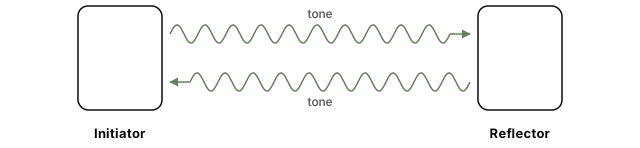
The figure below gives a brief overview of PBR. During PBR, the Initiator sends a carrier wave, which is a pure sine wave, to the Reflector. The Reflector makes a phase measurement, and then responds with its own pure sine carrier wave. Multiple measurements spanning several frequencies can be handed to an algorithm that precisely estimates the distance.
Round-trip Time
Round-trip Time exists for a different reason. The pure carrier waves that make PBR simple and precise also make it trusting. A sine wave carries no structure, so nothing about it proves who sent the signal or when it left the transmitter. A signal that an adversary can predict is a signal they can manipulate. RTT takes the predictability away by introducing a cryptographically random sequence known only to the Initiator and the Reflector. To an observer, the sequence appears as random structure. To the legitimate receiver, the signal verifies the sender and provides a method to measure the time of arrival directly.
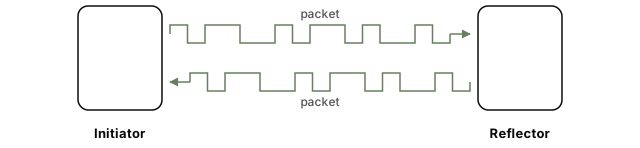
The figure below gives a brief overview of RTT. During RTT, the Initiator sends a scrambled packet to the Reflector at a known time. The Reflector estimates the time of arrival of the scrambled packet. Then, after a known delay relative to the time of arrival of the Initiator's packet, the Reflector responds with its own scrambled packet. The Initiator estimates the time of arrival of the Reflector's packet. Now, the Initiator knows the time between when it transmitted to the Reflector and when it received the answer back from the Reflector. And the Reflector knows the time difference between when it received the packet from the Initiator and when it transmitted the response. The missing time is the round-trip propagation delay of the channel, and is therefore proportional to the round-trip distance between the Initiator and Reflector.
Conclusion
You've now seen how Bluetooth Channel Sounding combines a single exchange between two ordinary radios with two complementary methods to produce a distance estimate you can trust on devices people already own. The door is now open for Bluetooth applications to add distance awareness, leveraging Bluetooth's low cost and long battery life. How PBR and RTT actually work deserves posts of their own, and those deep dives will be posted here.